
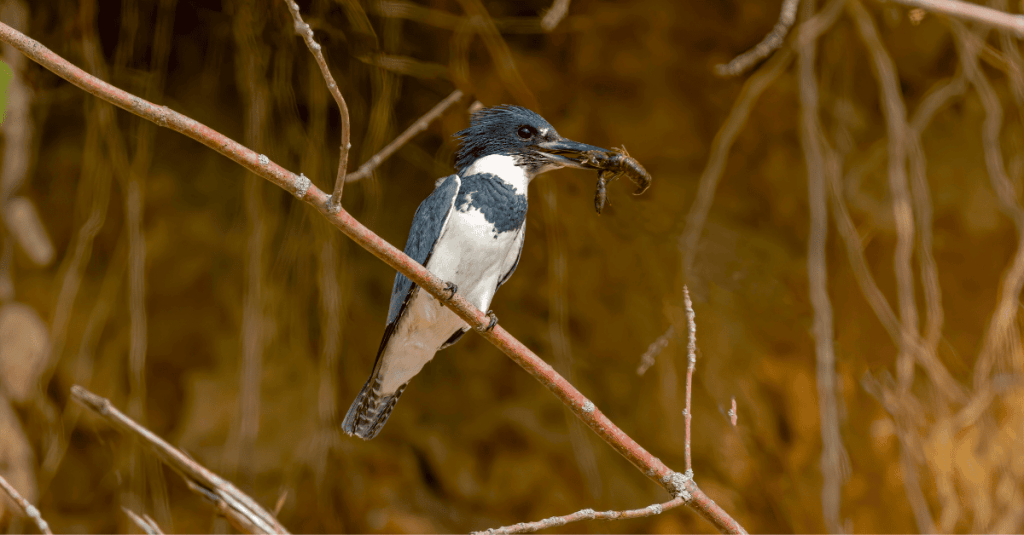
Haiku About Kingfishers: A Short Poem on the Belted Kingfisher
Some moments in nature are so special that remain in your memory long after you return to your everyday life. The belted kingfisher’s hunt is one of them—birds of blue-gray feathers and a spiked crest gliding over creeks and rivers, searching for fish below. I tried to capture the bird’s key features in this haiku:
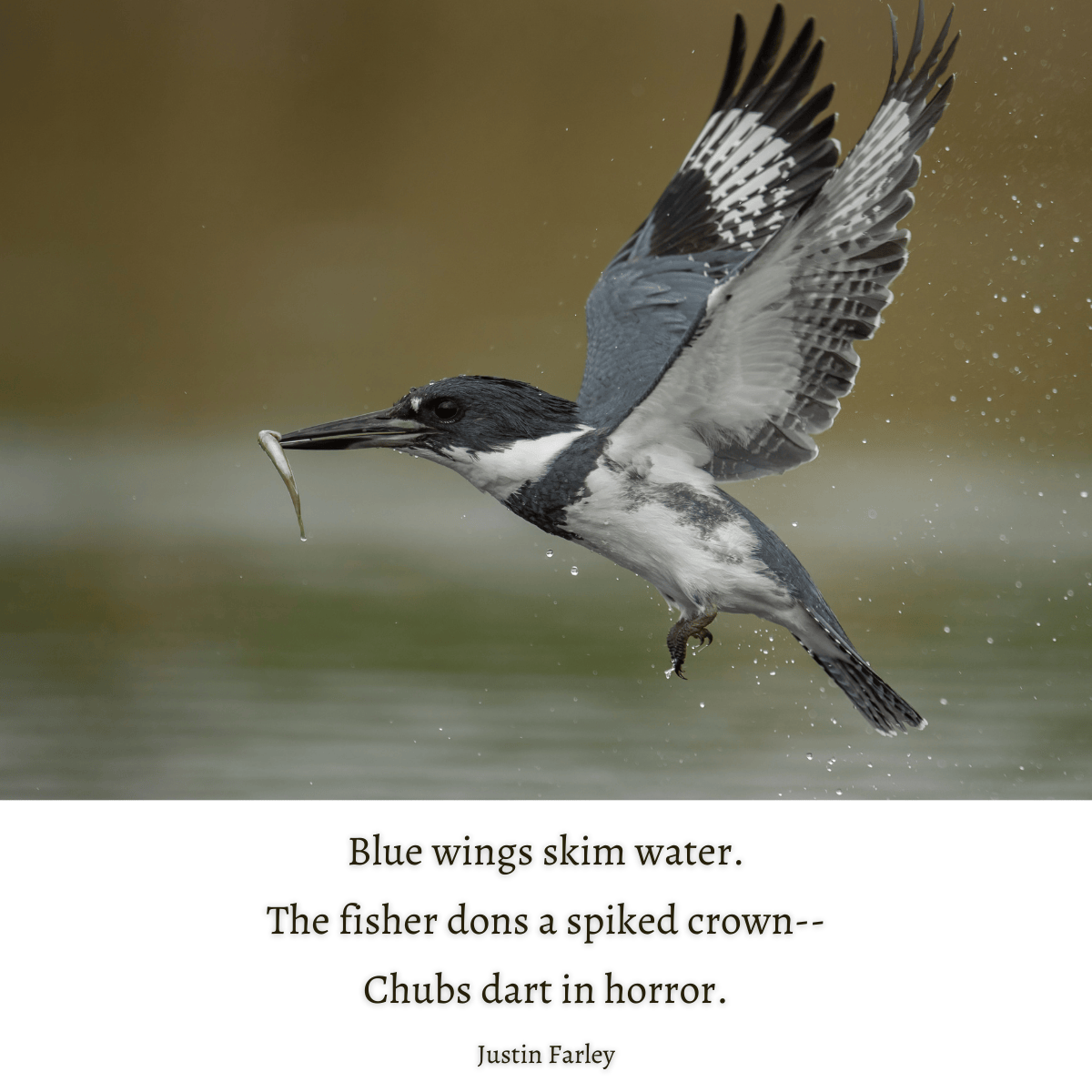
Blue wings skim water.
The fisher dons a spiked crown—
chubs dart in horror.
Justin Farley
My Personal Encounters with a Belted Kingfisher
I am far from an expert on kingfishers, but I do find them fascinating birds. Living in the mid-west, a lot of my outdoors time in nature centers around secluded woods with creeks, streams, and rivers. They are quick birds that you almost miss by the time you heard their call. On my hikes, I’m always on the look out for these beautiful birds and to see them glide across the water.
I will often head to the woods in the evening for a quick walk after being with kids most of the day to unwind. I wrote this poem on one my hikes the other night immediately after witnessing a belted kingfisher flying above a creek. Even as a boy I’ve had a special place for these birds because of the cool crest they have on top of their head that looks like a spiked crown.
Click Here For My Collection Of Nature Poems!

Kingfishers are remarkable birds with unique adaptations that make them incredible hunters. Here are some quick facts:
Fun Facts About the Fascinating Kingfisher
- Master Divers – Kingfishers have excellent vision and can adjust for water refraction, allowing them to pinpoint fish with deadly accuracy.
- Specialized Beaks – Their long, sharp beaks are perfectly designed to spear or grab prey from the water.
- Aerial Precision – They can hover over water before diving at speeds of up to 25 mph to snatch their meal.
- Unique Nests – Unlike most birds, kingfishers dig burrows into riverbanks where they lay their eggs.
- Symbolism – In different cultures, kingfishers represent peace, prosperity, and focus due to their calculated hunting style.

A Haiku About Birds: The Grace of the Kingfisher
The kingfisher is both beautiful and brutal. It’s swift and moves with grace. It wears its spiked crown like a ruler of the river, looking out across its dominion before striking with unrelenting speed. One moment, it’s perched in a overhanging tree—the next, it’s diving into the creek, and in an instant, it gobbles up its prize of fish.
There’s something mesmerizing about this beautiful bird that’s a small hunter. Fish dart to hide in cover—some escape in a frenzied flicker of silver, while others vanish into the beak of the hunter.
Click Here For My Bird Haiku Collection Page
How Does This Bird Poem Translate Into Our Lives?
It’s easy to admire the kingfisher as a master of patience. It waits. Watches. Moves only when the time is right. And when it does, there’s no hesitation. It reminds me how much of life is about timing—knowing when to act, when to wait, when to take the plunge.
Some cultures see the kingfisher as a symbol of peace, others of prosperity, but to me, it’s the embodiment of focus. An animal that doesn’t waste movement. The kingfisher symbolizes how important it is to act instead of react.
Acting Vs Reacting – Learning From the Kingfisher
It doesn’t spend its time soaring over the creek back and forth, wasting its energy. It perches itself in a place where success is likely to occur and waits for its moment. Not out of laziness but as a chosen act. But when their moment arrives there is no hesitation. The action is swift and all their energy that’s built up in their waiting explodes into blinding speed.

Our lives are often like this–or at least successful ones. It’s easy to get sucked into a cycle of constant action, always soaring over the river. But it’s tiring. And when we do get the opportunity for success, we either miss it because our field of vision is too broad or we’re too tired to put in the energy that the action requires.
Success Is Purposeful and Planned
Success is purposeful and mapped out. We decide where we should perch above the creek and wait, not jumping on distractions that don’t really align with out goals. When we seek out opportunity and trust that it will find us then we can dive at it and attack the work required with all our focus. We don’t just “wait” without action, though. It is purposeful and planned thoroughly in advance. We must decide what path most aligns with our goals, whether it has a good chance of success, and then stick to the path until there’s good reason to abandon it.
Fishing In Life Like The Kingfisher
In many ways, it’s like fishing. We all know the amateur fisherman or little kids who are constantly taking their lines out of the water and casting in the exact spot where someone else just caught a fish. They are restless, unfocused, and impatient, constantly changing lures and moving up and down the bank.
“Working the bank” can be successful if it’s a part of a planned strategy. The amateur, though, just moves everywhere without any idea of what they’re doing and assume that no fish are around if they don’t get a bite within a minute. Success takes time and patience. Of course there’s examples of overnight success, but they are outliers.
Trying To Do Too Many Things At Once- Spreading Yourself Too Thin
In this method of fishing, a good deal of time is spent casting, reeling, and walking to another spot. At times, these amateurs get lucky–this definitely seems to be the case with little kids. But day-in, day-out these strategies will fail because they are spending too much of their time on things that don’t align with the goal of catching fish. Too much of their time is spent without their bait near the fish.

The same is true in life. Instant success is a temptation, especially with modern technology. So many people try to replicate the success of some guru online when said guru would never give that information away if they really could replicate it time and time again. We must spend a lot of time planning our own path and then be patient, continuing to do the things that we perceive will lead to success so that we can dive at the opportunity when it comes just like the kingfisher.
Nature’s Poetry in Motion: A Haiku About Birds (5-7-5)
There’s poetry written into every movement of the wild. The flick of wings against water, the ripple of fear beneath the surface, the stillness before the strike. This haiku is just a small attempt to capture what’s already there—waiting for anyone willing to stop and see.
Take a moment the next time in nature to “write” your own haiku poem. It doesn’t actually have to be written if you’re not a writer. It’s more about being aware of what’s going on around you and capturing a moment, like a snapshot in your brain.
Notice the squirrels chase each other up a tree. What do their tails look like? Is their fur matted or fluffy? Pay attention to the way they jump from limb to limb without hesitation. So much of appreciating nature is just taking the time to notice what is already there. In our fast-paced society, we have all lost the ability in some sense to slow down and focus on one thing without getting bored or distracted. Nature is a great place to begin retraining your mind.
Have you ever seen a kingfisher in action? What moments in nature have made you pause and take notice? Drop your thoughts in the comments below.
Enjoyed this modern bird haiku about hawks? Here are a few other poems about birds as well as all my online nature poetry.
A Poem About Crows – Mysterious Birds of Intelligence and Wisdom
Haiku Poem About Barn Owls Birds 5-7-5
Short Haiku Bird Poem about Red Tailed Hawks 5 7 5
Owl Haiku Poem About Nature’s Wise Birds|Example 5-7-5


 ALONG THE BARREN ROAD
Leave a comment