

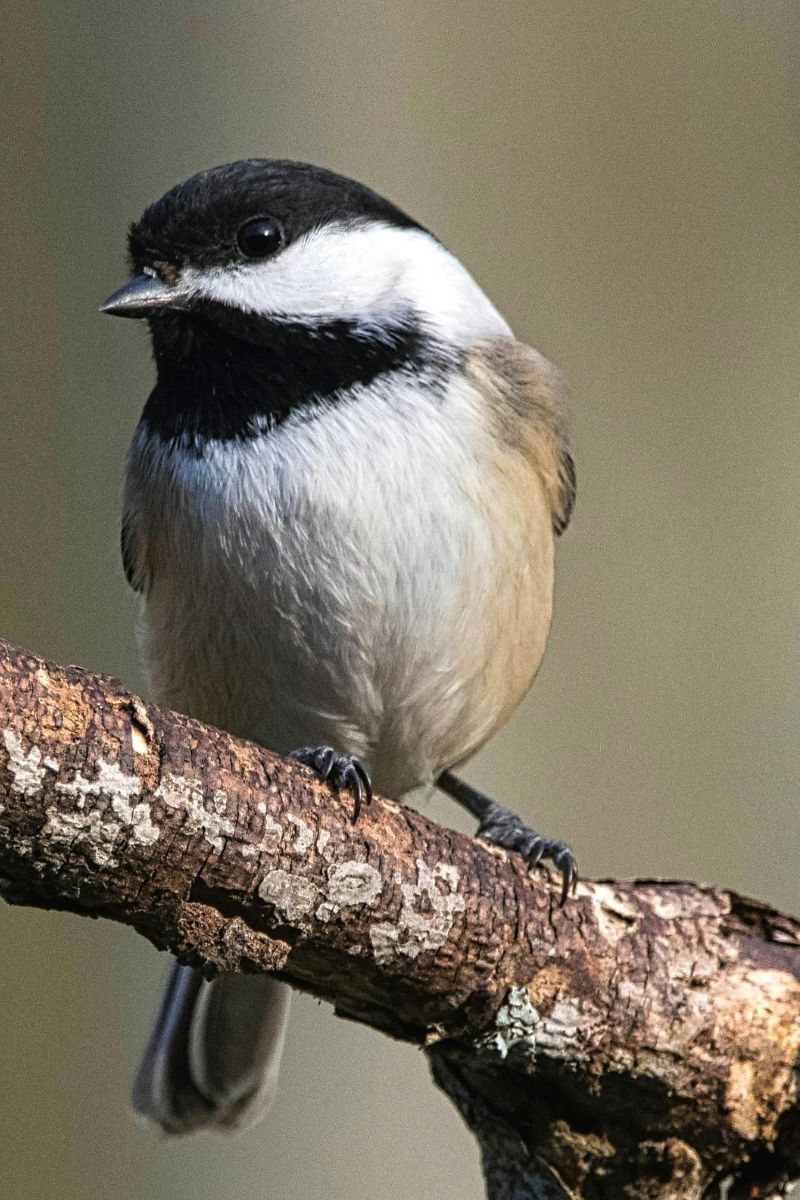
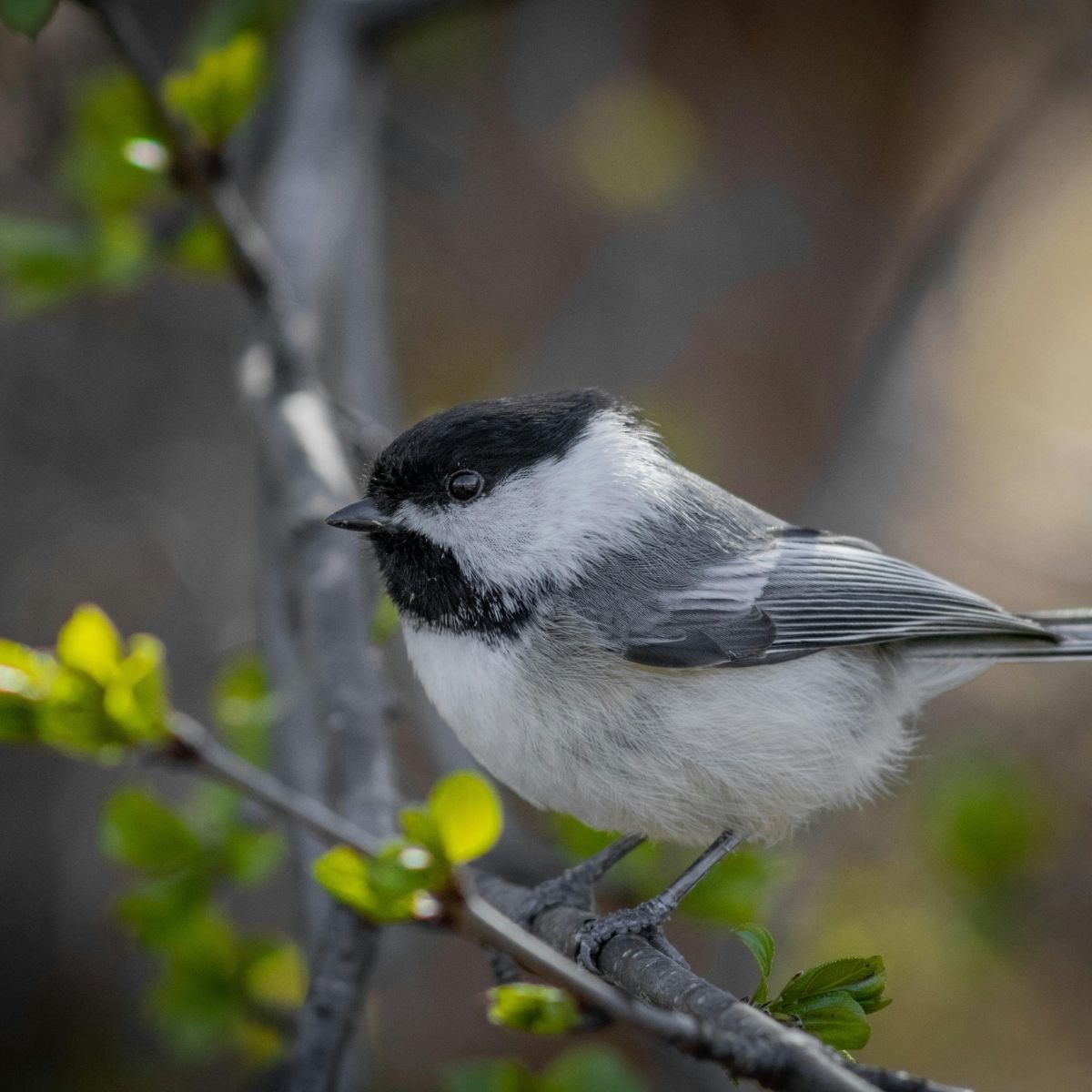
I’ve always loved to sit and watch birds on a feeder. The more mindful you are of them, the more you realize how many human-like traits they can have. The black-capped chickadee is a favorite of mine. They’re quick, twitchy, restless, and always have something to say. I may enjoy them because they personify my anxious tenancies!
Some Context On This Haiku About Birds
For as little as the chickadee is, though, they’re pretty bold and brash. They’ll eventually back down to larger birds but often not without a bit of a challenge. The black-capped chickadee is rarely patient, darting to and fro–flying from the feeder and flying back to it the next second.
I found out that this is partially due to the shape of its beak and not because it’s restless. Whereas finches or sparrows have beaks specialized in cracking open seeds without efforts, chickadees have a more “all-purpose” beak. This comes with advantages, but it’s a disadvantage at the feeder because it must fly to a perch and crack seeds open one at a time while holding the seed with its feet. Then it’ll come back for another seed, fly away, and repeat.
It seems that most feeders are rarely good places for them to crack open seeds. When they’re at an empty feeder its almost as if these unique birds are demanding more food. I tried to capture that moment in this nature haiku.

The chickadees wait,
hopping, twitching at feeders—
calling for their seeds.
Justin Farley
Click Here For My Collection Of Nature Poems!

10 Fun Facts About The Black-Capped Chickadee
- Exceptional Memory
Black-capped chickadees have great spatial memory, which means they are able to remember thousands of places they’ve hid food for up to 28 days. This amazing ability allows them to survive winters as they don’t migrate. - Complex Communication
Each one of their calls has a specific meaning. The “chick-a-dee-dee” call that their name comes from is actually a call of warning with the number of “dee”s changing depending on the threat. - Food Hiding Behavior
Chickadees hide seeds and insects in many locations or “caches”, such as dead leaves and cracks in tree bark to retrieve later when they can’t find food. - Ability to Change Their Temperature
These birds are able to conserve their energy on cold nights by lowering their body temperature by as much as about 54 degrees from their normal temperature of about 108 degrees, entering a state of adaptive hypothermia. - Nesting Habits
Black-capped chickadees have unique nesting habits where they often nest in tree holes no longer used by woodpeckers or by creating their own crevices. They use material such as animal fur or moss to make it more comfortable for their babies. - Long Lives
These tiny birds can live for a long time despite their size. The longest know chickadee lived up to 12 years old.
- They Have Complex Social Structures
During winter, these birds enter into a dominance hierarchy where the stronger birds have more access to food and resources in order to increase the chance of survival and reproduction. - Brain Changes
The hippocampus, which is the part of the brain responsible for memory, actually enlarges for chickadees depending on the season. It gets larger in the fall and winter, increasing spatial memory, allowing them to remember more places where they’ve hid food. - State Bird
The black-capped chickadee is the official state bird of Massachusetts and the general term “chickadee” as the state bird of Maine.
- Don’t Migrate
Many songbirds migrate during the winter, but black-capped chickadees have learned to adapt to the harsh, cold conditions by using their spacial memory capacities and their adaptive hypothermia ability. By using food caches, they are able to still find food when there isn’t any available.
Click Here For My Bird Haiku Collection Page
What Can We Learn From The Black-Capped Chickadee and This Bird Haiku?
Chickadees are often darting back and forth and staying in motion. As discussed earlier, this partially has to do with the way it eats. The second reason, though, is that it makes them harder to target by predators.
Learning to Adapt to Change
If there’s one word we can use to describe the lessons we need to learn from this bird, it’s “adaptability.” We often hear “the strongest survive” or “survival of the fittest” as it relates to evolution. But Darwin’s theory was better summarized in a quote often mistakenly attributed to him:
“It is not the strongest of the species that survives, nor the most intelligent that survives. It is the one that is most adaptable to change.” – Leon Megginson
The same is true for the human species. We put so much importance on strength and dominance that we underestimate how important being adaptable is. Without its spacial memory and its ability to manually enter a state of hypothermia to conserve energy the chickadee would have to migrate south.
Our talents and abilities are amplified if we don’t have to take the time to “fly south” all the time. If we can take shortcuts or learn to become more efficient, we will have an advantage over the strongest and even the most intelligent.
The World is Rapidly Changing as Technology Evolves
We live in a rapidly changing world. Technology is evolving all the time, and it’s hard to keep up. AI has just begun, and it’s already drastically changing the job market. In order to thrive in this world we’ll have to be able to switch strategies and shift our focus on a moment’s notice. The time where the “specialist” thrives is likely over.
It is the generalist who can do a long list of things and adjust quickly who has the advantage now. I’m not so sure that AI isn’t going to wipe out the opportunities for even the most adaptable among us, but I’m confident that those who don’t just rest on what they’re used to and are constantly learning are in the best position to succeed.
The chickadee gives us a framework of how to adapt and thrive despite being little. Change is coming. Are you prepared to adapt or will you pretend like you can do things the way you’ve always done them and won’t be left behind?
Poetry of Nature: A Haiku About Chickadee Birds (5-7-5)
There’s poetry waiting to be written or heard everywhere in nature. This haiku is just my own attempt to capture a moment of my own experience birdwatching.
Take a moment the next time you’re in nature to write your own haiku poem. It doesn’t actually have to be written if you’re not a writer. It’s more about taking the time to focus on a specific thing happening in nature and take a snapshot with your mind. What words would you use to describe what’s taking place in that “picture?”
Watch the creek as the water flows. What’s churning in the water? Sticks? Dead brush from the banks? A piece of trash from litterers? So much of appreciating nature is just taking the time to notice what is already there. In our fast-paced society, we have all lost the ability in some sense to slow down and focus on one thing without getting bored or distracted. Nature is a great place to begin retraining your mind.
Do you have a favorite bird you love to watch? Is it time to finally put that bird feeder in your yard you’ve been putting off? Drop your thoughts in the comments below.
Enjoyed this modern bird haiku about black-capped chickadees? Here are a few other poems about birds as well as all my online nature poetry.
Owl Haiku Poem About Nature’s Wise Birds|Example 5-7-5
Short Haiku Bird Poem about Red Tailed Hawks 5 7 5
A Poem About Crows – Mysterious Birds of Intelligence and Wisdom
Haiku Poem About Barn Owls Birds 5-7-5


 ALONG THE BARREN ROAD
Leave a comment