

Nature Greek Mythology Haiku Poem On the Pileated Woodpecker
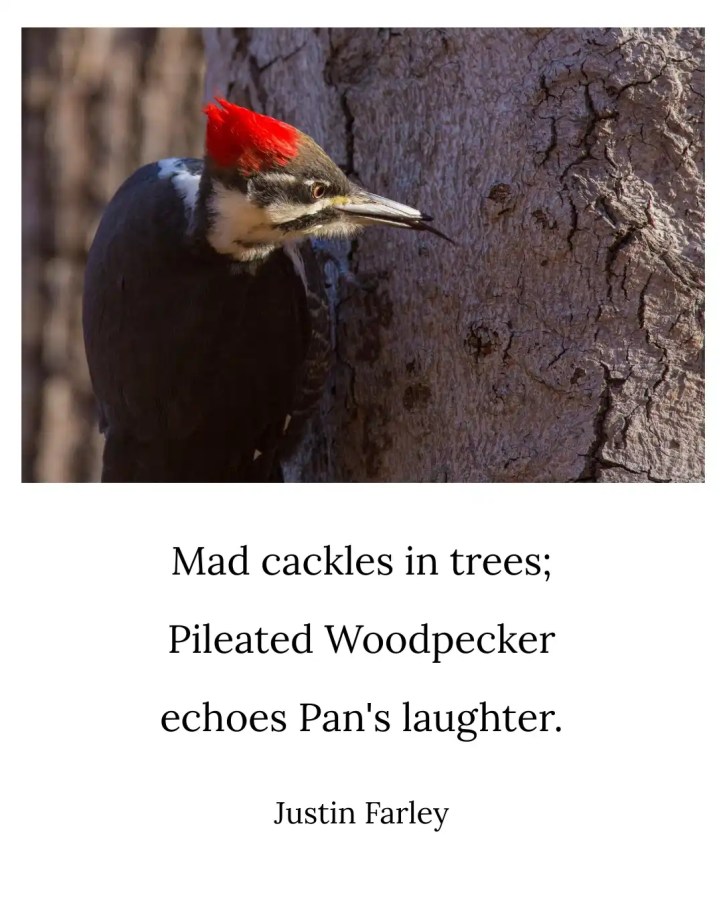
Mad cackles in trees;
Pileated Woodpecker
echoes Pan's laughter.

Justin Farley
Click Here For My Bird Haiku Collection Page

I’m always seeing Pileated Woodpeckers when I go on walks through the forest. Often, though, I hear them before I see them. They have a distinctive call that sounds more like maniacal laughter than a bird’s song (think Woody Woodpecker which was inspired by the Pileated Woodpecker). Sometimes, though, it almost seems to embody a “spirit” of nature, who is aware of our presence in the forest…a reminder that something ancient is here, something powerful, something that laughs at the arrogance and pride of humans. I wrote this short nature inspired haiku from my hiking adventure. I focused on incorporating the Greek god Pan into the poem because he was said to represent the wild parts of nature.
Click Here For My Collection Of Nature Poems!

I’ve done facts about the Pileated Woodpecker before in my other haiku you can find HERE. I decided to do this one centered around the god Pan in Greek mythology.
Interesting Facts About the Pan, God of the Wild
- Pan is the god of the wild, shepherds, and rustic music
He rules the untamed spaces such as meadows, groves, and mountain caves (not Olympus). He is the heartbeat of nature. - His name is where we get the word “panic”
Ancient armies feared sudden terror in the wilderness called panic, from Pan’s invisible presence. He was believed to instill fear with just his unseen gaze. - Pan’s appearance is part-man, part-goat
With goat legs, horns, and a bearded face, he symbolizes the combination of instinct and intellect. He is half wild, half wise. - He’s often associated with fertility and spring
Pan’s lusty energy made him a god of sensuality, fertility, and seasonal renewal. He chased nymphs, played flutes, and woke the sleeping world. - The pan flute (syrinx) is named after a tragic love story
He fell in love with the nymph Syrinx, who turned into reeds to escape him. Pan cut the reeds and crafted his haunting flute from her. - Pan was one of the few Greek gods said to have died
According to Plutarch, a sailor heard a divine voice cry out: “The great god Pan is dead.” Some see this as the old wild gods fading in the age of reason or Christ. - He was born in Arcadia, a region symbolizing pastoral purity
Arcadia became a poetic metaphor for untouched nature thanks to Pan. Even Renaissance poets praised it as an earthly paradise. - Pan was one of the few gods who could terrify even the Olympians
During the war against the Titans, Pan’s sudden shout caused the enemy to flee, giving us the mythic root of the word “panic” again. - He is a bridge between humans and nature
Pan doesn’t live in temples; his altar is the rustle of leaves, the howl in the hollow, the flute’s tremble at dusk. - Pan symbolizes both joy and dread which is the beauty and terror of the wild
He’s not evil, but he also can’t be controlled. He represents the freedom we long for and the chaos we fear. He is instinct, awe, and presence.
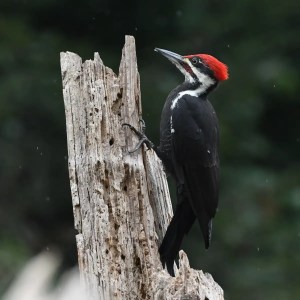
The next time you’re out in the wilderness, when you’re out there alone and all is quiet. Listen for the mad cackle of the Pileated Woodpecker as you wander through the woods. Be present and you may even feel an ancient presence watching, whispering.
Have you heard the Pileated Woodpecker? What did you think of its call? It’s a bit eerie if you’ve never heard it before. Drop your thoughts in the comments below.
NATURE | SPIRITUALITY | MENTAL HEALTH
Join my newsletter to receive new poems along with reflections on nature, spirituality, and mental health (usually a few times a month). My emails are intentional and never spammy—just words to carry with you.
Enjoyed this 5 7 5 nature haiku poem about Pan of Greek mythology? Here are a few other haiku poems about birds as well as all my online nature poetry.
Bird Haiku Poems Inspired by Nature 5 7 5
Short Haiku Bird Poem About Crows
Short Bluejay Poem Rhyming Bird Haiku
Short Bird Haiku Poem About Red Cardinal 5 7 5


 ALONG THE BARREN ROAD
Leave a comment